How to Sell AI Skills: Turn Your Expertise Into Recurring Revenue (2026 Creator Guide)
AI skills are the new digital product for creators, coaches, and consultants. What sells, how to package your process as a SKILL.md, where to publish so you actually get paid, and how to launch one.
AgentVolt · · 7 min read
Why this matters
If you have taught anyone how to do something - on YouTube, in a course, on a client call - you already have the raw material for an AI skill. A skill is a SKILL.md file that packages a procedure so an AI agent can run it: your cold-email checklist, your thumbnail process, your month-end close. People install it into Claude, ChatGPT, or Cursor, and the agent does the job your way.
Until recently there was no way to get paid for that. Skills lived on GitHub, directories indexed them for free, and the person who wrote the procedure earned nothing when ten thousand people used it. That changed in 2026. This guide covers what sells, how to package expertise into a skill people actually install, and where to publish so you earn recurring revenue rather than GitHub stars.
Why skills are worth selling now
Three things lined up. The format became an open standard in December 2025, so a skill you build once runs in Claude, ChatGPT and Codex, Cursor, GitHub Copilot, Gemini CLI, and 40+ other agents; you are not betting on one platform. Demand outran quality: an analysis of more than 47,000 public skills scored the average at 6.2 out of 12, and a Snyk audit found security flaws in more than a third of one registry, so a reviewed, expert-built skill stands out. And marketplaces with creator payouts appeared, which means the economics finally work.
The comparison to courses is useful. A course teaches a person a process and they may or may not use it. A skill is the process, installed, running every time they do the task. It is a smaller product with a much higher usage rate, and it compounds: the more skills you publish, the more a subscriber has reason to keep paying.
What kinds of skills sell
The skills that get installed share a shape. They replace a task someone does repeatedly, they produce a finished output rather than advice, and they encode a judgment call the buyer does not trust themselves to make.
Some categories that consistently work:
- A process you are known for. If your audience already associates you with a method - how you package YouTube videos, how you write proposals, how you run a weekly review - that method is a skill, and your audience is the launch list.
- The last-mile check. Skills that review and fix are easier to trust than skills that create from scratch. A "refine my cold email" skill outperforms a "write my cold email" skill because the user stays in control.
- Role playbooks. Bundles that cover a job - a PM toolkit, a finance close bundle, a creator sponsorship kit - sell to people who want one install, not twelve.
- Niche expertise. The narrower the better. A skill for HVAC local SEO or faceless-channel niche research has no competition and a buyer who searches for exactly that.
What does not sell: generic prompts ("write a blog post"), anything the base model already does well, and skills that are really just a persona with no procedure underneath.
How to package expertise into a skill
A skill has two parts: a short metadata block (a name and a description that says when to use it) and Markdown instructions - numbered steps, an output template, examples, and a gotchas section. No code required. Our SKILL.md guide has the template and the rules; here is the creator-specific advice.
Start from a real run, not a blank page. The best skills are extracted from doing the task with an AI and correcting it - "no, lead with the prospect," "never invent an owner for an action item." Those corrections are the product. Do the task three times with an agent, write down everything you fixed, and that is your gotchas section.
Write the description like a search result. The description is what the agent matches against, and on a marketplace it is also what the buyer reads. "Rewrites your cold email to be tighter, more direct, and far less likely to read as spam" tells both who it is for and what they get. "Helps with email" does not.
Ship an output template. A concrete format - the exact structure of the recap, the proposal, the brief - is what makes results consistent across a thousand users. It is also what makes a skill feel finished.
Keep it under 500 lines. The specification recommends keeping the main file under roughly 5,000 tokens and pushing long reference material into a references/ folder the agent loads only when needed. Buyers notice when a skill is bloated; the agent gets slower and less accurate.
Test it on someone who is not you. Hand the skill to a friend in your audience with a real task. If they have to ask you what to type, the description or the steps need work.
Where to publish
You have three options, and they differ mostly in whether you get paid.
Your own GitHub repo. Free, fully under your control, and the default for developer skills. No payment mechanism, no discovery beyond your own audience, and you handle support and updates.
Open directories. Sites like skills.sh and SkillsMP index public skills and make them installable in one command. Good for reach among developers; still no payment, and your skill sits next to hundreds of thousands of unreviewed ones. Our marketplace comparison covers each.
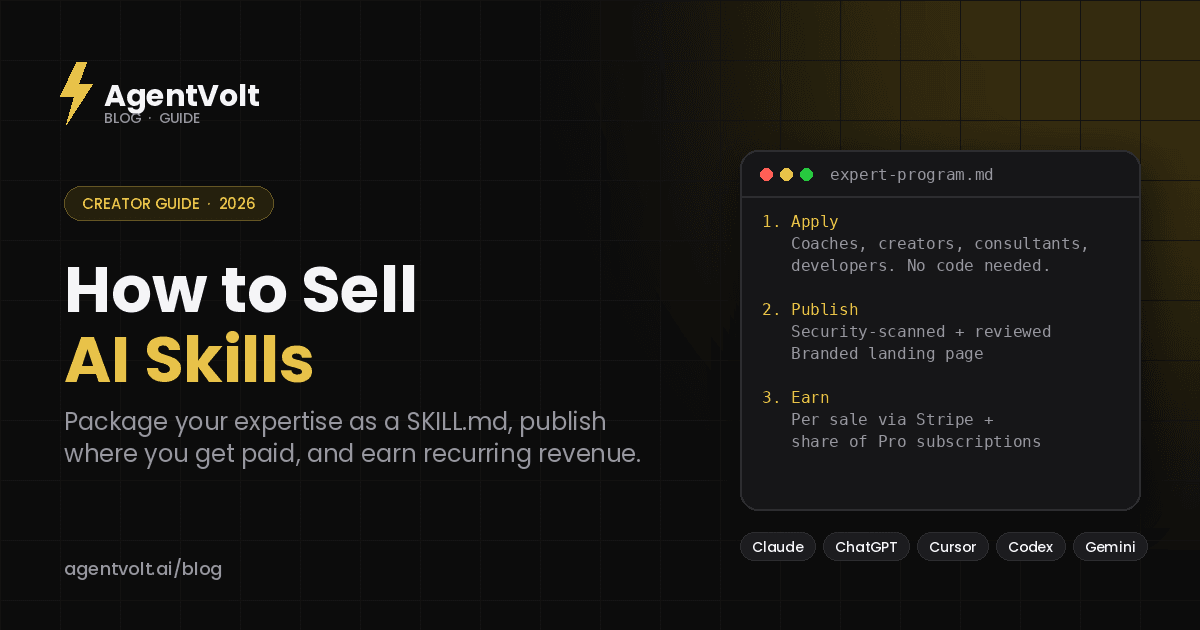
A curated marketplace with creator payouts. This is the option built for people with an audience. On AgentVolt, the process is apply, publish, earn: you upload a skill, it is security-scanned automatically and then reviewed by a person before it goes live, and you earn on every sale through Stripe plus a share of AgentVolt Pro subscription revenue when subscribers use your skills. You also get a dedicated branded landing page - your name, your skills, one link to send your audience. The program is open to anyone with real expertise worth packaging: coaches, consultants, agency operators, developers, creators. You do not need to know how to code.
Several of the most-installed skills on the marketplace came from creators rather than the AgentVolt team - the Content Repurposing Engine, AI Research & Briefing Agent, and Earnings Report Analyzer among them. Each is a practitioner's real process, packaged.
How to launch a skill
Publishing is the easy part. Getting installs is a distribution job, and creators have the advantage here.
Make the skill the payoff of a piece of content. A video or post that walks through your process, then ends with "or install the skill and let Claude run it" converts far better than a bare link. The content is the demo.
Use the branded landing page as the single link. One URL in every description, bio, and newsletter footer; it becomes the place your audience goes for anything you build.
Ship one skill, then a second within a month. A single skill is a product. Three related skills are a reason to subscribe, and subscription revenue is where the recurring part comes from.
Update it when the agent gets something wrong. Every correction you make is a version bump, and versioning is visible to buyers. A skill that has been improved four times reads as maintained; one at v1.0.0 for eight months does not.
What to expect financially
Be realistic about the shape of the curve. Individual skill sales are lumpy and track your content calendar. Subscription revenue share grows more slowly and does not go away: a subscriber who installed your skill in March is still counted in September. Creators who treat this as a compounding library rather than a launch do better over a year, and the ones with an existing audience get there faster than the ones building one alongside.
The other thing to expect is that quality is enforced. Review and scanning exist so buyers trust the marketplace, and that trust is what makes a $49-a-month library sellable at all. A skill that gets sent back with notes is normal; it is the process working.
Frequently asked questions
Do I need to know how to code to sell an AI skill?
No. A skill is a Markdown file with instructions. Scripts are optional and most skills do not include any. If you can write a clear procedure, you can write a skill.
How do AI skill creators get paid?
It depends on the marketplace. Open directories pay nothing. On AgentVolt, creators earn on each sale, paid out through Stripe, plus a share of subscription revenue when Pro subscribers use their skills.
Will my skill work in ChatGPT and Cursor, or only Claude?
The SKILL.md format is an open standard supported by Claude, ChatGPT and Codex, Cursor, GitHub Copilot, Gemini CLI, and 40+ other agents. One skill file works across all of them.
What if someone copies my skill?
Skills are text, and text can be copied. What cannot be copied is the audience, the branded page, the version history, and the trust that comes from being the person who built it. Publish where your name is attached, keep improving it, and the copy stays a copy.
Package the thing people already ask you about
You do not need a new idea. Take the process people email you about, the one you have explained a hundred times, and write it down as steps with a template and a gotchas list. That is a skill. Publish it where you get paid, put the link in your next piece of content, and see what happens.
Apply to the AgentVolt Expert Program - publish your skills, get a branded page, and earn on every sale and subscription.
Skills in this post
Every one is included with AgentVolt Pro.
Content Repurposing Engine
Turn one video or transcript into a week of posts — threads, shorts scripts, newsletters — in your voice.
AI Research & Briefing Agent
Turns any topic, company, or person into a tight, sourced briefing you can read in two minutes.
Earnings Report Analyzer
Paste a 10-K, 10-Q, or earnings call transcript — get the numbers that matter, the narrative changes, and what the CFO tried to bury.